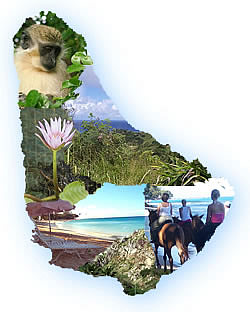
Insights to Barbados. These are in-depth articles of people and places in Barbados. Ian Clayton, a keen observer of people, writes about characters and situations he encounters while weekending and working in barbados villages and towns.
Programming once meant learning the language of the machine.
Increasingly, the machine is learning ours. Natural-language AI tools
let people describe objectives, request software, and refine solutions
through conversation.
That could make programming accessible to many
more people while changing the skills professional programmers need in
an AI-assisted world.
Here are the to 10 take-aways from the blog on Identity is Fragile. This precedes "Who Needs Identity Anywayy" Both examine the effect of AI on our future. In some sense its like looking at Identity in Crisis. But ity's not all doom andd glome and the series exposed mayny benifites from living with AI.
10 Reflections from Identity Is Fragile
1. Identity Is More Fragile Than We Imagine We often think of identity as something permanent. Yet history shows that identity continually adapts to changing cultures, communities, and experiences. It evolves throughout our lives, often more quickly than we realise.
These reflections are drawn from the RoguesCulture essay Identity Is Fragile. Read the complete article to explore the full story and continue the conversation.
2. Identity Is Shaped by Culture Culture gives us language, traditions, humour, values, and belonging. Identity does not exist in isolation. It grows within the communities that nurture us and changes as those communities change.
3. History Leaves Its Mark The legacies of slavery, colonialism, migration, and freedom continue to shape identities today. Identity is not inherited unchanged; it is continually reinterpreted by every generation.
4. Identity Lives with Contradiction Barbados illustrates that identity can hold multiple truths at once. African heritage, British institutions, Caribbean culture, and modern independence coexist—not as confusion, but as a living conversation.
5. Belonging Can Change Belief People naturally seek community and certainty. Sometimes our desire to belong quietly reshapes how we think, what we believe, and ultimately who we become.
6. The Environment Shapes Identity New workplaces, new friendships, new technologies, and new communities all influence our sense of self. Identity is continually responding to the world around us.
7. Identity Requires Curiosity Strong identity is not rigid identity. Curiosity allows us to remain confident in who we are while remaining open to learning from others.
8. Identity Is Not Just Inherited Identity is built through daily choices. The work we do, the relationships we form, the values we practise, and the stories we tell all become part of who we are.
9. Artificial Intelligence Changes the Conversation As AI begins to shape how we learn, create, communicate, and make decisions, identity enters a new chapter. Technology does not replace identity, but it may influence how identity develops in the future.
10. Identity Is Precious Because It Is Fragile Perhaps identity should never become armour. It works best as a bridge between people rather than a barrier between cultures. Protecting identity begins with understanding both ourselves and one another.
We are living in a dangerous moment in history. Technology is accelerating. Artificial intelligence
is going to reshap work and communication. Cultural tensions are rising. Outrage spreads faster than understanding.
Many feel unsettled, scared and worried. They are unsure of who they are
becoming in a world that seems to move faster that they can think.
By the eighteenth century, Barbados was home to bustling Saturday markets where enslaved and free Black vendors bought, sold, bargained, saved, and reinvested. Contemporary travellers repeatedly remarked on the scale and efficiency of these markets, astonished by their profitability and discipline. They were not chaotic spaces of survival; they were systems of enterprise.
Barbados’s dense plantation layout and early sugar dominance made these markets unusually efficient. Short distances allowed goods, information, and money to circulate rapidly. What emerged was not merely a coping mechanism but a working economic model — one that would be replicated across the Caribbean as plantation systems spread outward from Barbados.
This is where the Bajan reputation for thrift, enterprise, and market savvy was forged. Not as myth, but as necessity. Not as resistance alone, but as strategy with confidence, independence of thought, and a deep understanding of value. They seeded the entrepreneurial instincts that later carried Barbadians across the Caribbean, Britain, and North America — small island people navigating global systems with sharp minds and steady hands.
Barbados did not just export sugar and plantation practices. It exported ways of surviving, trading, and thinking economically under constraint. In that sense, the island was not simply part of Caribbean history — it was one of its blueprints.
Chattel
houses were born in the years after emancipation, when freedom came without
land. Plantation owners expected freed people to stay in the same place,
working the same fields, in the same dependency. But Barbados had other ideas —
and so did the people who built their lives on its narrow ridges and coral
plains.
Imagine
it: a whole society of people who owned their home, but not the soil beneath
it. The chattel house solved a contradiction that the colonial system never
intended to fix. Built on loose coral stones instead of foundations, it could
be lifted, shifted, swung around, mounted on a cart, rolled by neighbours, and
replanted somewhere else — often overnight.
It
was architecture as resistance.
Ingenuity disguised as simplicity.
A house that refused to be held hostage.
The
elder leaned forward, lowering his voice as if sharing a secret.
“You
know what a movable house does to a people? It teach them that belonging is not
something to wait for — is something you carry.”
This
story is part of the deeper cultural journey explored in Rogues in Paradise
and the RoguesCulture Identity Series.
If
you’d like to explore more stories like this — stories of resilience, humour,
rebellion, and belonging — you’re invited to the early pre-screening of the
work that started it all.